We write the book in your voice, build the funnel behind it, buy the media ourselves, and hand you every buyer as a named person on your own list.
A book is the only asset that makes somebody trust you before you meet. They pay for it, they spend hours inside how you think, and the first conversation starts at the detail questions instead of at the introduction. That is the whole mechanism, and it is the one we ran on ourselves first.
A week to a live funnel · Three or four hours of your time · Nothing to schedule to read this
WHAT WE DO FOR PEOPLE WHO WOULD RATHER NOT
That is what a referral does, and it is the only thing that has ever reliably worked for people who sell what you sell. We build the whole machine and you pay for the people it delivers. Forty-one of the sixty are a machine’s job, twelve need your judgement rather than your time, and the remaining seven are ours to do by hand. The year it takes to find out which is which is a year of the work you are actually good at — so we do it, on your business, and carry the risk of it while we do.
Nothing to build it. You pay per named buyer, at a price locked before we start. If our cost to acquire them rises, that is ours to absorb, not yours.
No setup fee, no retainer, no percentage of ad spend, and no minimum spend of your money running in the background. We do not bill for effort, because effort is our problem. You prepay a refundable balance and we draw it down only as leads actually land. That risk transfer is the product — everything else is how it gets delivered.
A refundable balance, drawn down only as named buyers land.
That is the list.
We have written that out in full because it is the offer. Read it back and notice what is missing: there is no month in which you are paying us and nothing has arrived. That month is the one every retainer is built out of, and it is the reason this is priced the way it is.
If we are wrong about your arithmetic, we find out on our money, in our ad account, before you have paid for a single name. That is not generosity. It is the only structure that lets us mean the price we quoted.
Write your book, build the funnel, and run the media on our own ad accounts. All sixty steps, on your business — you do the twelve that need you.
A named person who paid for your book and is on your list. Not an impression, not a click, and emphatically not a reply to would you like to see a case study.
Everything up to the handoff happens in our systems, so a lead is countable in a payment ledger. Nothing to adjudicate, and no definition for you to lose an argument about.
The book, the site and every lead — including if you leave. Month to month, no minimum term, no exit fee.
How many people could ever buy from you. A wide market and a single vertical are different machines, not one machine at two prices, so there is no rate card.
The twelve steps no software will do — the judgement only somebody who knows your field can bring. We bring the machine, you bring that. Neither half works alone.
A written verdict inside five business days: yes at a named volume and price, or no with the numbers that make it a no. An honest no is the deliverable, not a failed sale. It is real work, so it is not free — and if it is a yes, what you paid comes off the engagement in full. We offer it to people who have read the book, because we would rather you understood the method before we ran your numbers.
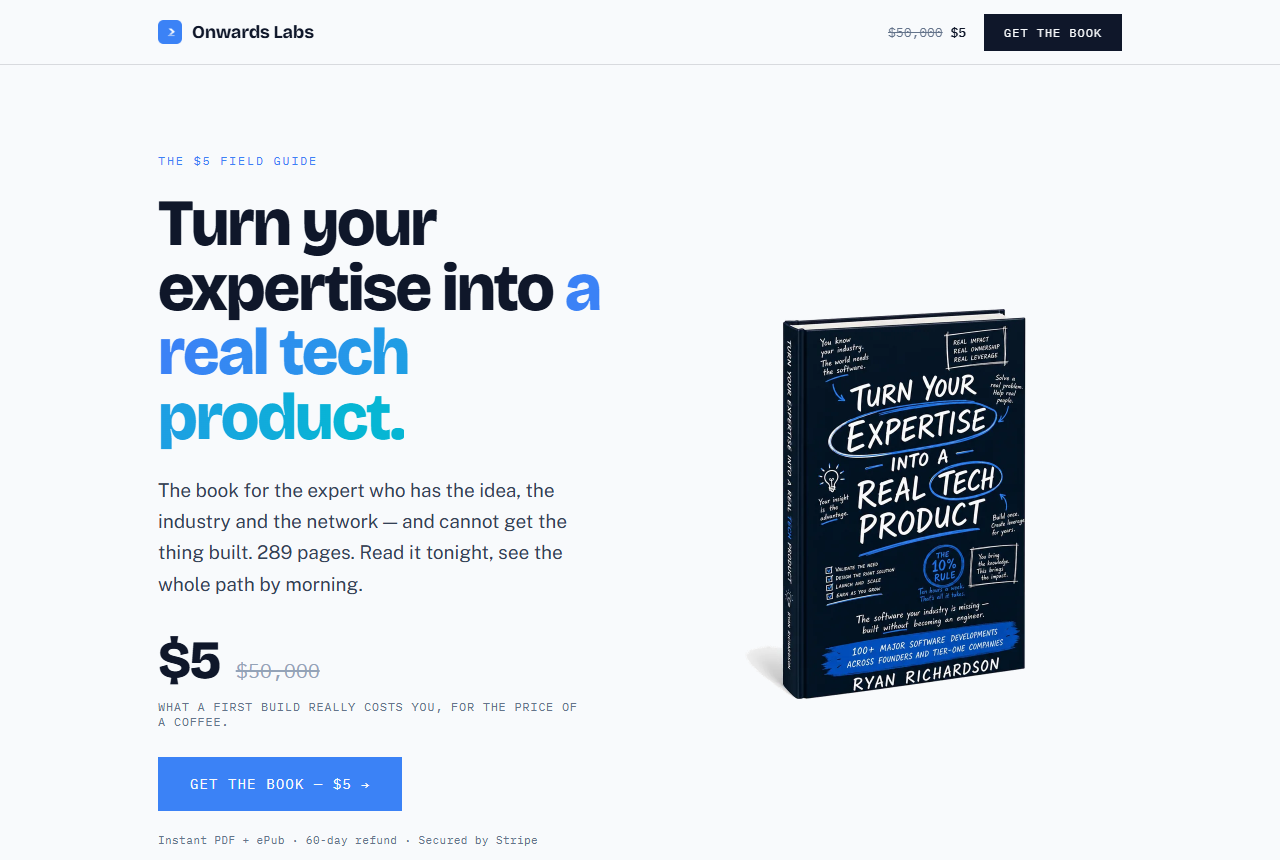
You already have the whole method for five dollars. If you hire us and we get it wrong, you know exactly what we were supposed to do, step by step, with the failure mode written next to each one. That is the opposite of every agency relationship you have been in, and it is why we published it.
You keep the manuscript files, the cover, the site, the domain, the list and the ad creative, in the formats they were built in, handed over inside ten business days of you asking. Not a login to something of ours. We hold the ad accounts and the machine that runs them; you hold everything with your name on it, and it is in the agreement before you commit to anything.
No. It comes off the engagement in full, which means the diagnosis was free and you got a written second opinion on your own arithmetic for nothing. If it is a no, you keep the arithmetic and we keep nothing.
We do not run this from a call — you will have noticed we said nothing to schedule twice already, and we meant it. Everybody who ends up working with us reads the book first, because we would rather you understood what you were handing over before you handed it over, and because a good share of readers discover at step 3 that they should not hand it over at all.
When you have read it, we will offer to run your numbers properly: five business days, a written yes at a named volume and price, or a no with the arithmetic that makes it a no. It is real work so it is not free, and if it is a yes what you paid comes off the engagement in full. We only offer it to people who have read the book, which is most of the reason the book costs five dollars and not nothing.
Read the method — $5 USDA question the page did not answer? ryan@onwardsanalytics.com.au
WHY WE CAN AFFORD TO CARRY THAT RISK
Because that is what the challenge above returned, and we counted every dollar of it. Labs was not the only thing we put through the account either — between January and September seven of our own products ran through it, across 46 campaigns and 2,128 ads, every dollar ours. Six did not work. One did.
Both rows are books, sold out of the same account on the same pixel. Sixteen campaigns sold seven copies between them; the four with all sixty steps behind them sold ninety-nine. Thirty times the rate. The three rows add up to the whole account — 46 campaigns, 24,221 clicks, 108 buyers — so nothing has been left out to make the gap look bigger.
So a book is not the mechanism. Publishing one and hoping is how you get the middle row.
One product runs its own funnel and may never have reported to this pixel. One converts inside a free chat rather than at a checkout. Several campaigns were traffic or lead buys never optimised for a purchase at all.
Reading those as sales failures would be judging a test against an intent it never had — step 58, and we are not going to break our own rule to make a chart look better.
AND WHAT THAT ACTUALLY COST
You cannot buy this by spending money on advertising — that is what we tried first, and it is most of the list further up. What it actually cost was years, two people who do this for a living rather than as a side project, and three complete rebuilds of the machine underneath, each one because the build before it was wrong in a way only running it could reveal.
Measured on our own funnel, 1 January to 31 August: A$48.72 to acquire a book buyer, A$31 back per buyer from the book and its two add-ons — that is the four campaigns above, the same ones that produced the ninety-nine. Roughly two-thirds of the media returns before we bill a client anything, which is steps 3 and 50 and the reason the offer can exist at all.
One thing that number is not: the price. What we spend to acquire a name is our arithmetic, not yours. Yours is what a client is worth to you over their whole life with you, multiplied by how often a book buyer becomes one — and for the people this works for, those two numbers are not close. A firm that has published its own costs is not the same as a firm that prices off them.
That is what lets us quote a fixed price per lead and mean it.
We already know what acquisition cost does when it moves, because we have paid to find out repeatedly. You do not repeat the years. You get the machine on day one and you pay for what it delivers.
You have proved you can sell a five-dollar book to people like me. You have not proved that a person who buys my book becomes a client of mine.
That is correct, and it is the right question. We can show you the front half in full — that a book at the end of sixty steps sells thirty times better than our earlier ones did without them, out of the same account, on the same pixel. We cannot yet show you the back half on somebody else’s business, because we have been the somebody else. The first cohort is the first cohort, and pretending otherwise would be the exact behaviour this page spends eight thousand words objecting to.
What we can do is refuse to guess. Step 3 of the book computes what a book buyer is worth to you, from your own figures, before anybody has spent a dollar. The verdict runs it properly and returns a yes at a named volume and price, or a no with the arithmetic attached. If the number does not carry, you will hear it from us in five days — and we would rather lose the engagement there than find out together in the ninth month, on your list, with your name on the book.
The names further up are twenty years of analytics work, and they are the reason we can read a number properly. They are not evidence that we can fill your pipeline, and we are not going to pretend otherwise — nobody should buy this because BHP appears on a page. What is evidence is the funnel you are standing in, with every figure from it published, including the sixteen places it went wrong. A small machine you have counted honestly beats a big one you have not, and every claim here was cheap for us to check and is cheap for you to doubt.
WHETHER THIS IS YOU — AND MOSTLY IT IS NOT
Fit is one number: what a customer is worth to you over their lifetime, multiplied by how often a book buyer becomes one. Lifetime value, never the size of a single deal. A firm selling million-dollar engagements that closes one a year from a huge pool is a worse fit than a smaller service that closes often and repeats.
Take what a client is worth to you over their whole life with you. Multiply it by the share of book buyers who become one. That is what a name is worth to you — and it is the number we quote against, never the size of a single deal and never our own costs.
If a client is worth thirty thousand to you over three years and one book buyer in two hundred becomes one, a name is worth a hundred and fifty dollars to you. If it is one in a thousand, it is thirty. Those are different machines carrying different prices, which is why there is no rate card and why we will not guess in front of you.
Run it yourself before you speak to us. It is steps 2 and 3 of the book, and the model is the forty-seven-dollar add-on if you would rather not build it.
Most businesses do not clear that sum, and we would rather tell you inside five days than take your money and find out together in five months.
THE CASE STUDY — WE SET OURSELVES THE PROBLEM FIRST
We had the problem, so we took one of our own businesses and gave it the whole method — no shortcuts, no borrowed template, every asset built from nothing. “We built a funnel” is exactly the kind of claim that costs nothing to make, so here is what it actually meant. All of it is live at onwardslabs.io, and you are welcome to go and pull any of it apart.
Most of these are the unglamorous ones. Nobody sells a course on making sure a campaign parameter survives into a payment record, which is precisely why almost nobody has one.
Three rebuilds, not one. The first two were wrong in ways only running them could reveal, and the third still carried bugs the first two had taught us to look for. That is the honest shape of this work, and it is the reason the engagement is priced the way it is.
QUESTIONS ABOUT THE ENGAGEMENT
It depends entirely on how many people could ever buy from you, because a wide market and a single vertical are different machines rather than one machine at two prices. We will not quote a number before running your arithmetic, and putting a rate card here would be exactly the guessing this whole page argues against. The written verdict names the volume and the price together, because neither means anything alone.
Then we will tell you, and that is the end of our commercial interest in you — worth saying out loud, because it is unusual. It is not the end of yours. The number that decides it is step 3, and the model that computes it is the forty-seven-dollar add-on at checkout, which is the same model we run. Most people who fail step 3 fail on frequency rather than deal size — how often a buyer becomes a client, not what a client is worth. That is a fixable thing, and it is fixable by you, in the book, without us. A no from us is a finding about this month, not a verdict on your business.
A named person who paid for your book and is on your list. Not an impression, not a click, not a form-fill from somebody who wanted a free PDF. Everything up to the handoff happens inside our systems, so it is countable in a payment ledger rather than argued about in a monthly report.
Because we have already paid to learn what it does when it moves, on seven of our own products over eight months, and because the front end funds itself — the book and its add-ons return roughly two-thirds of what the advertising costs before we bill a client anything. Anybody who needs a retainer before touching your account is telling you their own front end does not work.
No. Your leads are yours, along with the book and the website, and you keep all of it if you leave. Month to month, no minimum term, no exit fee. We keep the machine that produces them and the front-end revenue that funds the advertising — and we put that in writing before you commit to anything.
Onwards Analytics has been doing analytics work for large organisations for two decades, across seven businesses and more than a hundred technical projects. This particular machine — book, funnel, media, all sixty steps — we built for ourselves first, over years, and rebuilt three times. That is where every number on this page comes from. We would rather tell you that plainly than show you a wall of logos, because a wall of logos is exactly the kind of claim that costs nothing to make and tells you nothing, which is the argument the whole page rests on. Judge the work; it is five dollars to check.
WHERE IT STARTS
We have to underwrite every prospect anyway. Charging for it means you get the analysis whether or not we work together, and you reach the decision having already seen your own arithmetic.
We take this on where a customer is worth roughly $180,000 USD or more over the whole relationship. Below that the arithmetic does not carry, and the verdict will say so.
Would rather read the method first? The whole thing is $5 USD →