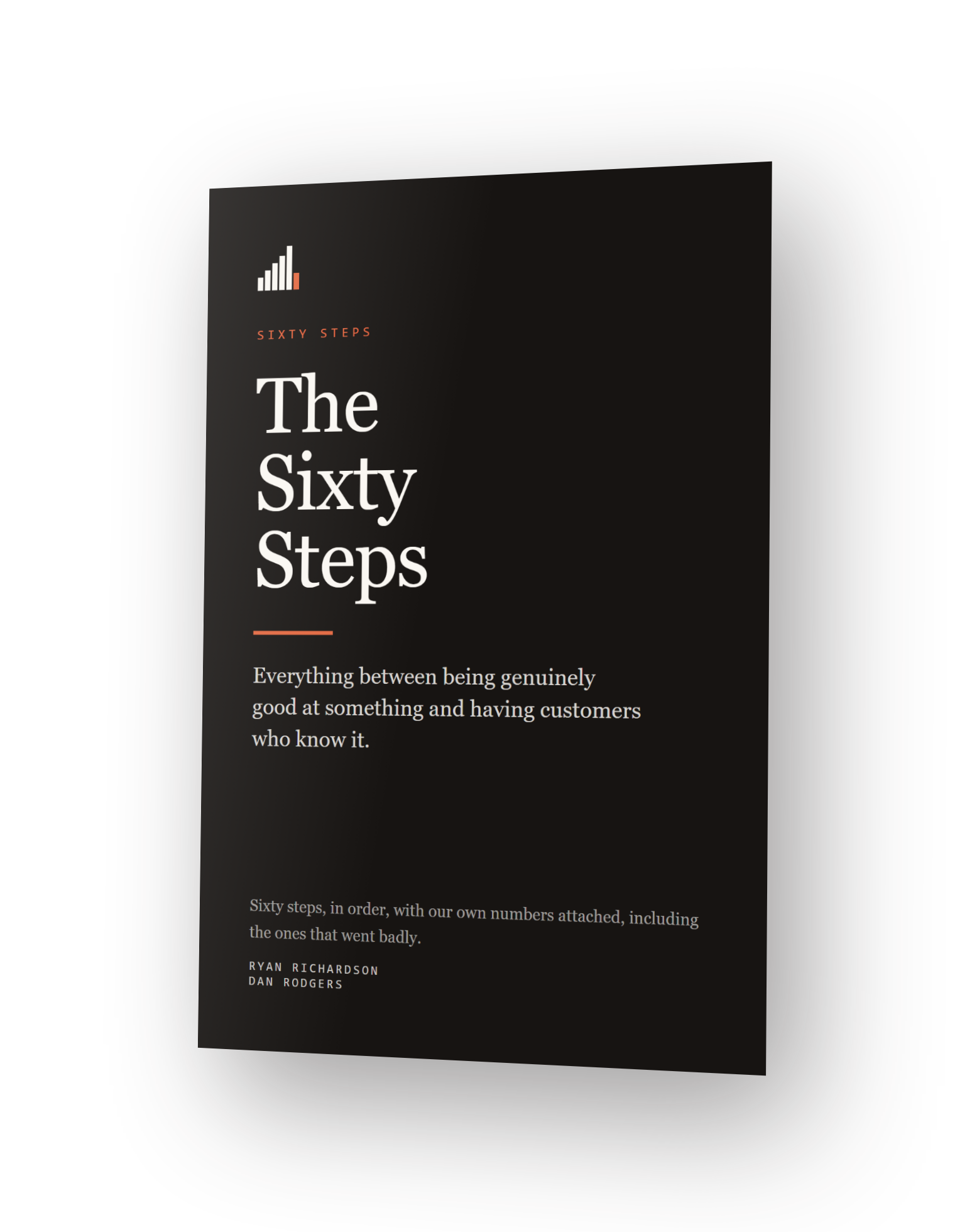
Twenty years of being genuinely good at something and invisible for it, then twenty years of measurement discipline pointed at our own marketing. This is what it took, in order.
Not a summary and not a teaser. The sixty steps are the same ones we run for clients who pay us to do it for them, including the arithmetic, the thresholds, and the ones that did not work. Nothing is held back for the engagement.
Read it, decide whether the reasoning holds, and run it yourself. Most people should.
179 pages · Instant download · No email required to read this page
THE BOOK
179 pages
Sixty steps, in order, with the numbers that decided each one
WHAT WE HAVE WRITTEN
4 books
This is the fourth, and the only one about the machine itself
Everything we tried is below
SEVEN BUSINESSES·100+ TECHNICAL PROJECTS·2,128 ADS GRADED·KPMG · BHP · SOUTH32·FOUR BOOKS·ONE MACHINE THAT FINALLY WORKED
WHAT WE BELIEVE, AND MOST OF OUR INDUSTRY DOES NOT
Nobody has the insight. Including us.
Figures below cover ads with at least 500 impressions, because a rate on fewer than that is noise. The product every agency actually sells is insight. They know what works. They have a feel for it. They have seen a thousand accounts and will bring that judgement to yours. We spent several years testing that proposition, mostly by discovering we were wrong. Every one of these was a case where the sensible reading, the one an experienced person arrives at confidently, was not slightly off. It was backwards.
01Click-through rateWe posted 22% and were quietly pleased with ourselves. It sold nothing — though in fairness that ad was never trying to, and counting it as a sales failure would be the mistake in link 07. So here is the like-for-like, inside the campaigns that were actually selling: the best rate that sold nothing is 5.72%, every ad that ever converted sits between 1.54% and 6.24%, and ranked by click-through rate the bottom half of our ads outsold the top half, 51 to 40.
02Cost per clickClicks in the sets that sold nothing cost us 13¢. The clicks that actually bought something cost A$1.23 — nine times more. Cheap traffic is not the same as traffic that can afford you.
03EngagementWe tested two versions of a page. The winner lifted how far people read by sixteen points, a large lift by any standard, and sold fewer books than the version it beat.
04Average order value$16.57 against a break-even floor of $20–40. We treated a pricing problem as a traffic problem for months.
05Reported returnAn ad set the platform scored at 0.06 — six cents back per dollar — that we were about to switch off. On money that had actually settled in the bank it was returning 1.55.
06Attribution$0 creditable on a live, well-built funnel, because campaign parameters never reached the payment record. Not less accurate. Impossible.
A testing problem wearing a knowledge problem’s clothes.
Marketing presents as something you would fix by finding the person who knows, and that is what is sold across our industry: a framework nobody else has, an angle, a hack that is working right now. We looked for those for twenty years, on our own money, and they do not exist.
Knowledge problems are solved by finding the right person to tell you. Testing problems are solved by doing sixty things in order, instrumenting each one, and letting the numbers tell you which of your opinions to drop. Solving this is a data science problem more than a marketing one, which is why so few marketing firms solve it.
Three things follow, and between them they are the whole business.
1If nobody has the insight, the method is not the scarce part — so we can print all of it.
2Being wrong is not something to hide. It is the only real evidence that anything was being measured.
3We cannot turn round and ask you to buy our insight — which decides how the engagement is priced.
An agency that has never been wrong has never measured. We can show you sixteen times we were, with the numbers. Ask how many vendors have ever shown you one.
WHY WE ARE THE ONES WRITING THIS
A fair question: why take marketing advice from a data and analytics firm?
Because we had your problem, badly, for about twenty years. We did not study it — we were stuck in it, and a firm that spends two decades being good at something and invisible for it eventually has to solve the problem properly instead of intuitively.
RR
Ryan Richardson
Founder, Onwards Analytics
A decade sitting between executives and engineering teams — at KPMG, BHP and South32, and across ventures of his own. The job has always been the same one: turn what the business needs into what engineers actually build, and catch the expensive mistakes before they are made.
7 businesses100+ technical projects$3m+ platform in year one
DR
Dan Rodgers
Marketing lead, Onwards Analytics
Runs the offer, the positioning and the creative — the half of the sixty that decides what you sell and to whom, before a line of it gets built. He wrote parts I to V of the book; Ryan wrote VI to IX. Every section says which of them is talking.
THE PART WE WOULD RATHER NOT TELL YOU
We have also killed a product together.
It demoed beautifully and topped out at about fifty percent accuracy in production, after real money and two years had gone into it. We wrote the kill verdict down instead of quietly reallocating people and hoping.
That document is more use to us now than the product would have been — and it is the same instinct that produces a page like this one.
And we run our own company on the machinery this describes.
Payments, reporting, marketing, support, quality control. The advertising account grades itself against the payment ledger overnight and says which of our opinions were wrong while we were asleep. A client’s compliance report assembles itself from live data every week without anybody touching it. We are not describing a method we admire. We are describing the one we are standing inside.
TWENTY YEARS OF PROBABILITY AND BEHAVIOURAL ANALYSIS, FOR ORGANISATIONS LIKE THESE
THE CASE STUDY — WE SET OURSELVES THE PROBLEM FIRST
The Onwards Labs challenge: could the sixty steps work on us?
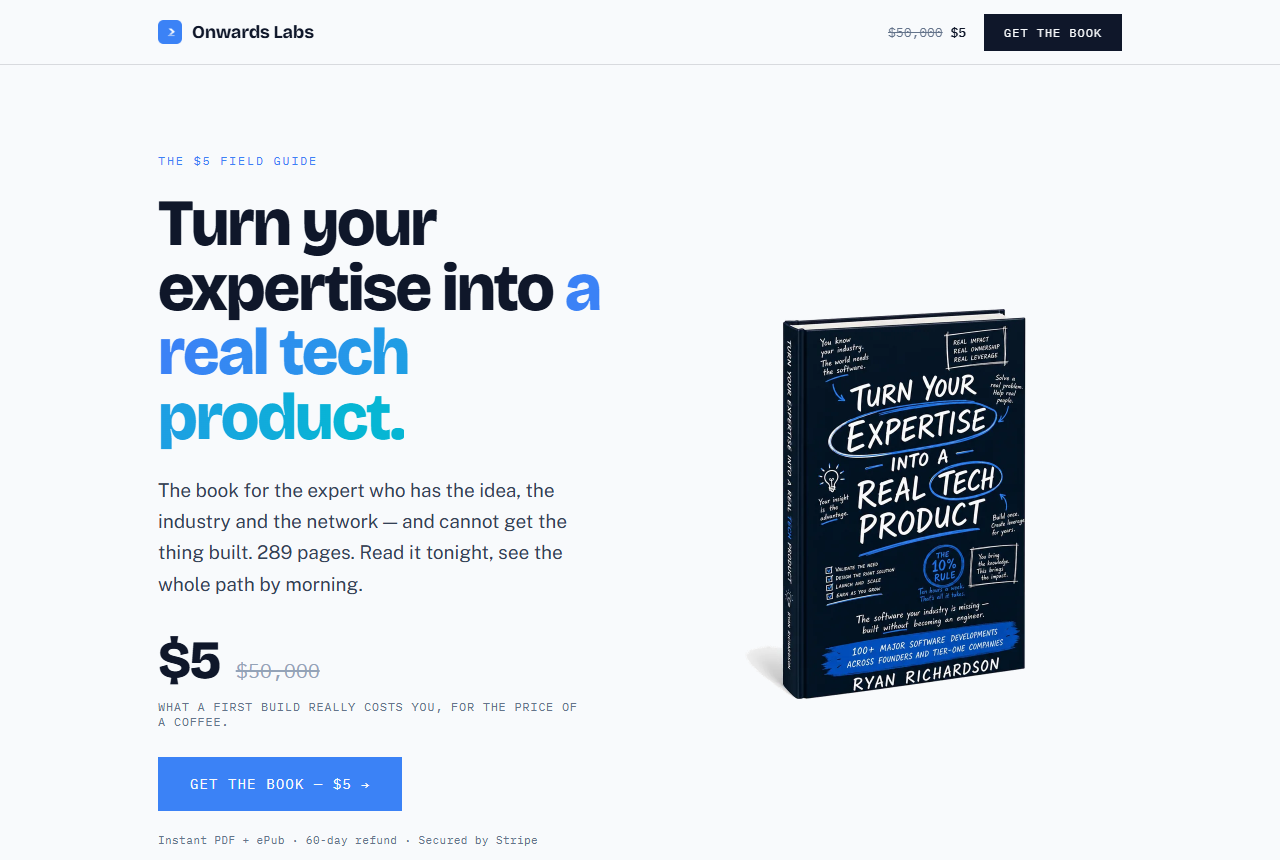
We had the problem, so we took one of our own businesses and gave it the whole method — no shortcuts, no borrowed template, every asset built from nothing. “We built a funnel” is exactly the kind of claim that costs nothing to make, so here is what it actually meant. All of it is live at onwardslabs.io, and you are welcome to go and pull any of it apart.
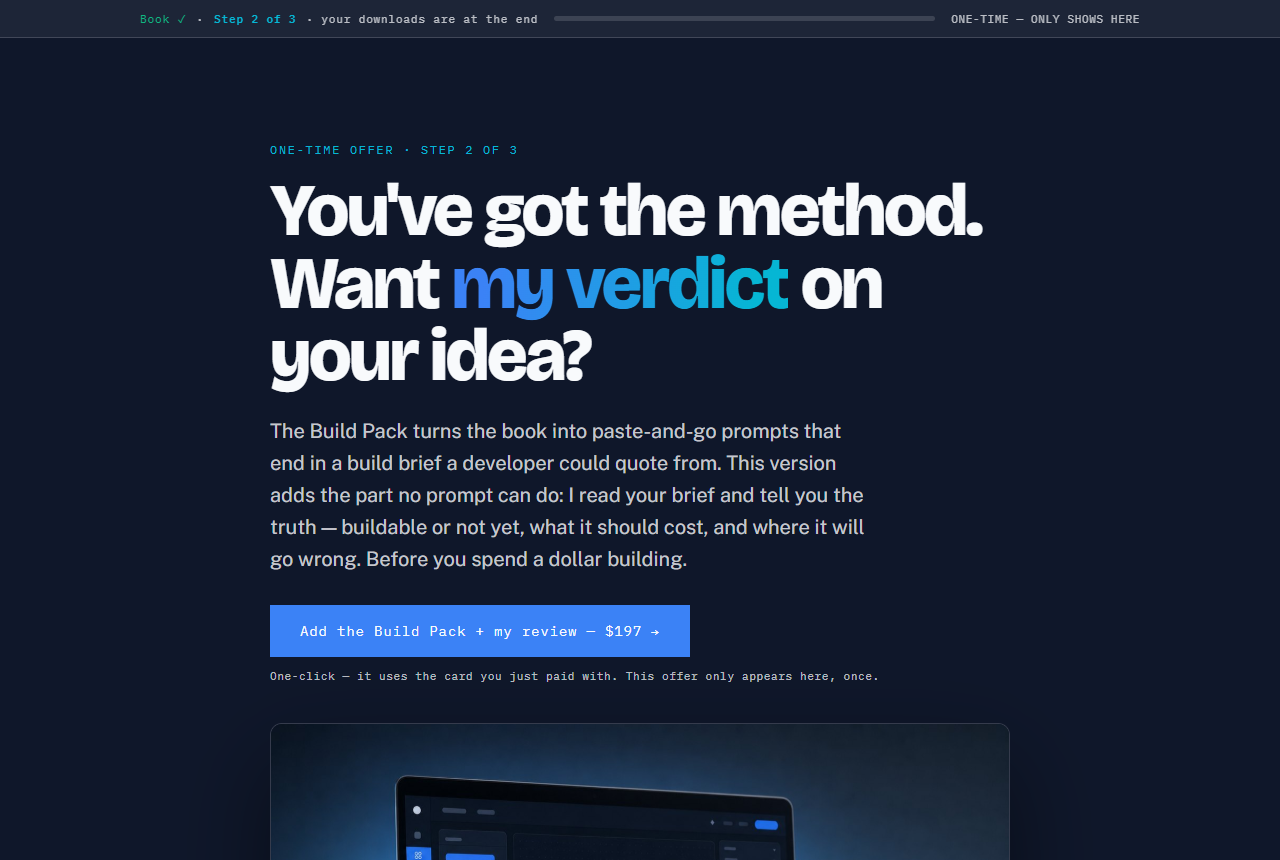
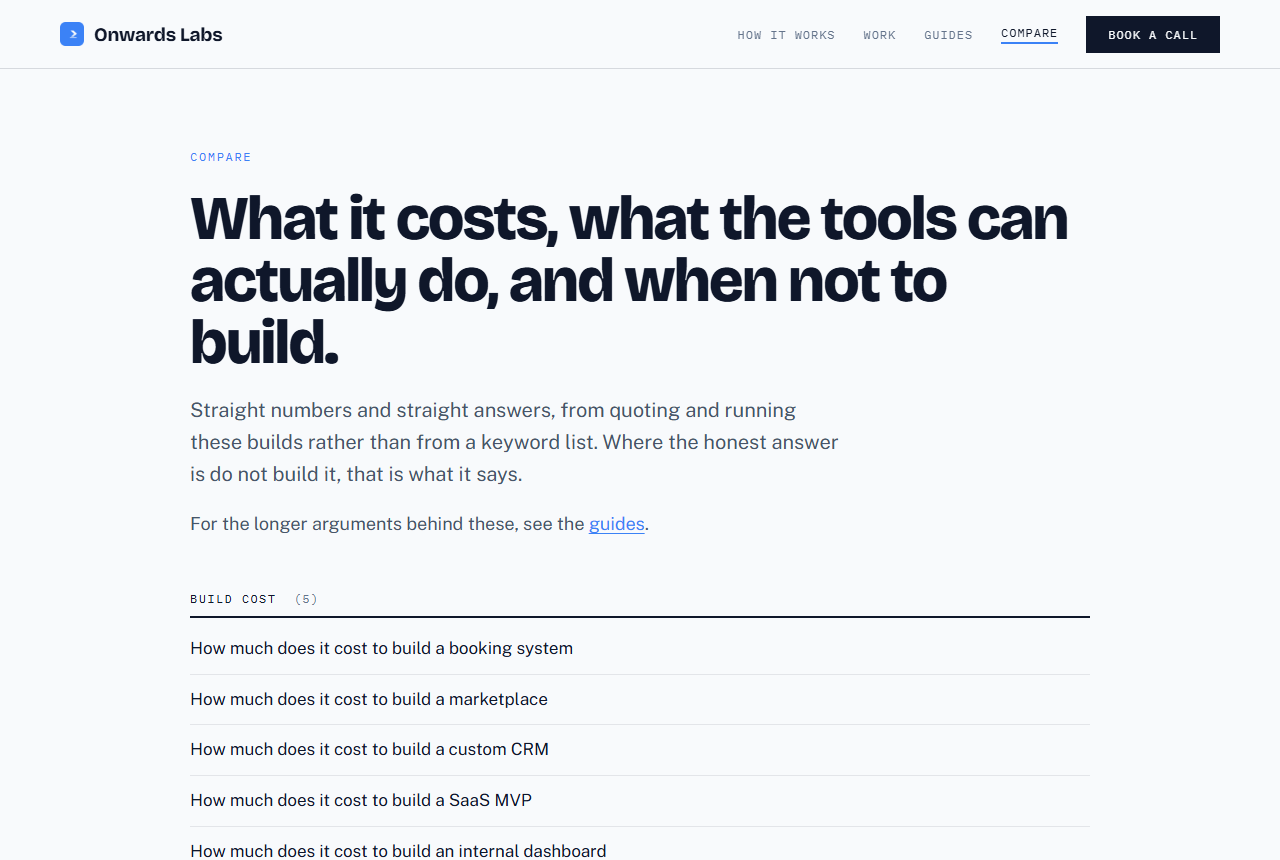
The sales page. Step 34 onward — written on the assumption the hero is all most people will ever see, then rebuilt twice after the numbers disagreed with us.The post-purchase chain. Steps 37 to 39 — card saved at first purchase, one-click upsells off session, consent matched to price. Eleven pages sit behind the checkout.The second front door. Step 42 — twelve comparison pages and five long articles, because paid was never the only way in and should not be the only one you build.And the business behind it. The funnel is not a marketing artefact bolted onto a company. It is the front of one, which is the only configuration where the arithmetic works.
EVERY ASSET IT TOOK, COUNTED
This is what sixty steps looks like when somebody actually does all sixty.
Most of these are the unglamorous ones. Nobody sells a course on making sure a campaign parameter survives into a payment record, which is precisely why almost nobody has one.
1book, held to a scored floor before it was allowed to ship
40pages built — sales, checkout, delivery, thank-you, intake
9post-purchase pages: order bumps, one-click upsells, downsells
7products behind the paywall, each a real file rather than a placeholder
15comparison pages and long articles, as the second front door
229ads written and graded for this one product, out of 2,128 account-wide
190scripts in the shared pipeline that generates, scores and grades them
183commits on this one funnel, across three complete rebuilds of it
57failure modes documented along the way — one per step
Three rebuilds, not one. The first two were wrong in ways only running them could reveal, and the third still carried bugs the first two had taught us to look for. That is the honest shape of this work, and it is the reason the engagement is priced the way it is.
THE FOURTH BOOK, AND THE ONLY ONE ABOUT THE MACHINE ITSELF
The entire method is written down. Read it before you let us near your business.
All sixty steps in the order they have to happen, each with its tools, its failure mode and whether it can be automated. Where a step cost us money to learn, the amount is in the text. Nothing is held back for the engagement — forty-one of the sixty run without a person, but only because there is real software underneath that has been wrong many times and corrected each time, and that is the part you cannot get from a prompt.
THE TRADE, SAID ON THE FIRST PAGE OF THE BOOK TOO
About ninety-nine readers in a hundred will take what is in here and use it without ever speaking to us. Some will run the whole thing themselves. Some will hand it to somebody they already employ and finally know what to ask for. Some will reach step 3, do the arithmetic, find their numbers do not work, and save themselves a year and a great deal of money. Every one of those is a win, not a consolation prize.
Perhaps one in a hundred will finish it, look at how much of it there is, and decide they would rather hand it over. That is the other win, and it is the one this is built to earn. It only works because it is almost wastefully generous to the ninety-nine — you either give it all away or you do not.
Went wrong — our numbers publishedNeeds your judgement, not ours
PART IDecide what you actually sell
PART IIMine the market
PART IIIExtract the point of view
PART IVWrite it
PART VProduce it
PART VIBuild the machine
PART VIIInstrument it — the part everyone skips
PART VIIICreative and launch
PART IXRead it and decide
THE WAY IN
The Sixty Steps, $5 USD.
ABOUT $7.20 AUD · CHARGED IN US DOLLARS · YOUR BANK CONVERTS
PDF, sent to whatever email you use at checkout, usually within a minute. Read step 3 first — ten minutes, one number you already know — and if it comes out wrong you have saved yourself a year. That is a real outcome, and it is the most common one.
The Sixty Steps
179 PAGES · NINE PARTS · SIXTY STEPS
$5 USD
~ $7.20 AUD
✓Start at step 3. Ten minutes, and it decides whether the other fifty-nine are worth your time — the one number, from your own figures, that we compute before we take anybody on
✓All sixty steps in order, each with its tools, its failure mode and whether it can be automated
✓The sixteen we got wrong, with our actual numbers attached
✓Fifty-seven documented failure modes, and the sixteen that cost us money carry the figures
✓Sixty days to ask for your money back, and you keep the book either way. Nobody has ever been frightened of losing five dollars — what you are risking is an evening, so read step 3 and if that one number does not change how you think about the next twelve, ask for the five back and keep the rest
TWO OPTIONAL ADD-ONS — BOTH SEPARATE WORK, NEITHER HELD BACK FROM THE BOOK
Refundable on request · No email required to read this page · Nothing to schedule
QUESTIONS ABOUT THE BOOK
Asked before you asked.
Onwards Analytics has been doing analytics work for large organisations for two decades, across seven businesses and more than a hundred technical projects. This particular machine — book, funnel, media, all sixty steps — we built for ourselves first, over years, and rebuilt three times. That is where every number on this page comes from. We would rather tell you that plainly than show you a wall of logos, because a wall of logos is exactly the kind of claim that costs nothing to make and tells you nothing, which is the argument the whole page rests on. Judge the work; it is five dollars to check.
Because knowing the sixty and doing the sixty are not the same job. Most readers will do a handful and stop, which is not a criticism — it is what happens when you already have work to deliver. The ones who go and build the whole thing themselves were never going to hire anybody, and we would rather find that out at five dollars than at the end of a sales process.
No. Every step on that list is in the book in enough detail to execute. The two add-ons at checkout are separate pieces of work — one live funnel’s actual assets, and a working spreadsheet — not chapters removed from the book to create a reason to buy them.
Ryan Richardson and Dan Rodgers, of Onwards Analytics. We each wrote the parts we actually run — Dan the market and positioning half, Ryan the build and instrumentation half — and every section says which of us is talking. The figures throughout are from our own firm’s ad account and payment ledger.