Tiny course · $27
Get it for $27
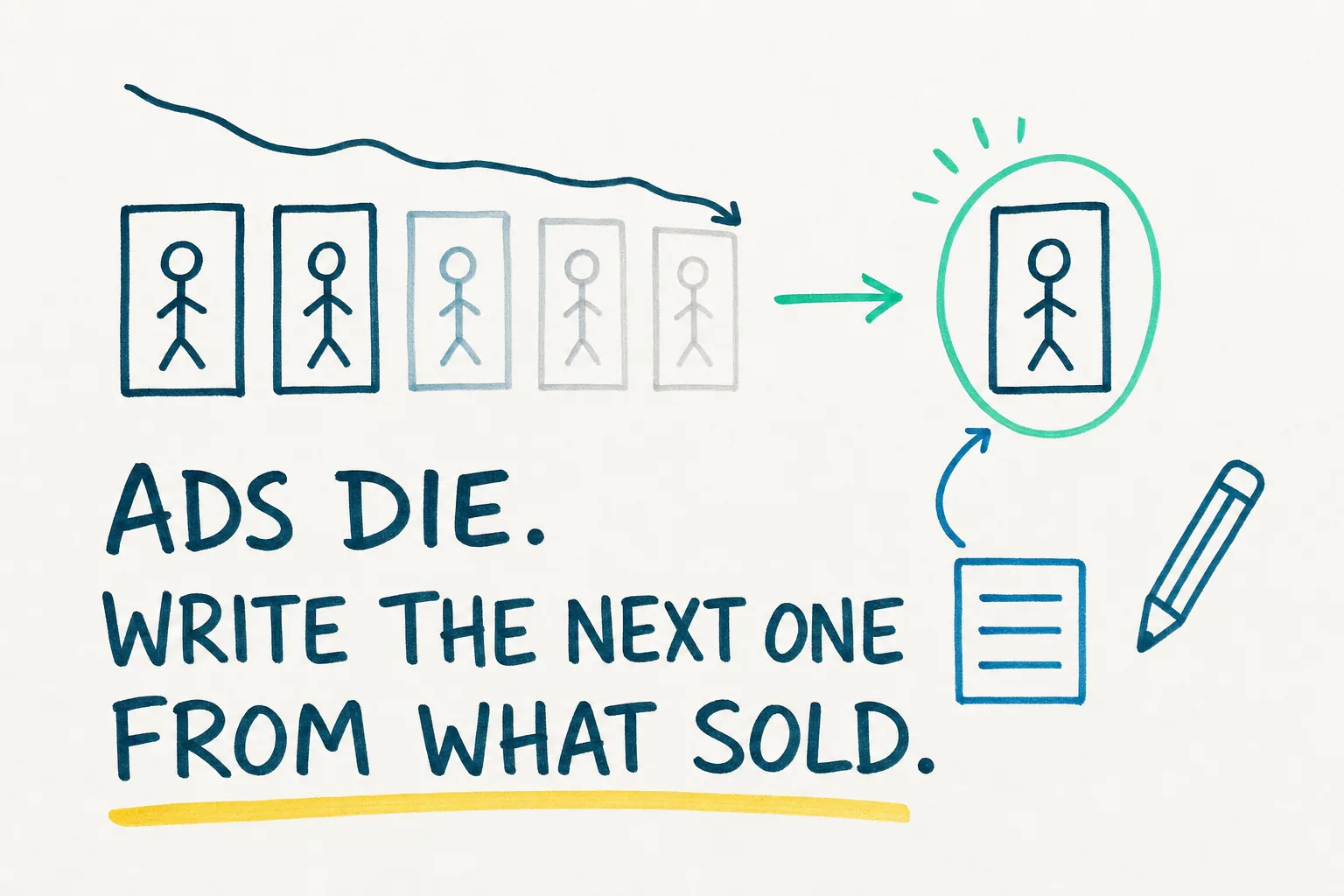
Ads die on a schedule. The fix isn't a bigger swipe file, it's a weekly habit that writes the next batch from this week's settled money.
Most ad review is a vibe check: someone looks at the ad, likes it or doesn't, and it ships. There's no repeatable test behind that judgement, so there's nothing to learn from when the ad fatigues and dies, and no reliable way to know what to make next.
This course is a mechanical fix, taken from the exact material in The Book Is the Funnel (Part 4: Creative) and our own account history: a three-gate screen for every ad before it spends, the reason near-identical ads compete with themselves and die faster than they should, and the weekly habit that turns this week's settled Stripe revenue into next week's brief.

“Ads that look alike in layout, lighting and framing get collapsed into one competitor inside the same auction, which means twenty near-identical ads are competing with themselves for delivery rather than reaching twenty different buyers.”

I built analytics models for banks and miners before this. This course is built from the exact material in The Book Is the Funnel and our own account history, not from a script written to sound good.
Every bonus below is a tool or a book part sold on sixtysteps.co today, at today's price. Your bonuses arrive in your inbox the moment you pay. The course itself stays delivered by email.
Dear reader,
If you have read this far, you have probably already decided whether $27 is a risk worth taking. It is less than one hour of a strategist’s time. So the rest of this page is not about the lessons. It is about who is teaching them, and why this is six lessons, not sixty.
We are an analytics firm that got into Meta ads by accident, found that nobody was measuring them properly, and started fixing that one step at a time. This course is one of those steps.
My name is Ryan Richardson. For 6 years I built analytics models for banks and mining companies through a firm called Onwards Analytics. The brief was always the same: two systems that should agree do not, and someone senior needs to know which one to trust before the Monday meeting.
I had run Meta ads on and off for about five years. Once we ran them for our own offers, I was staring at the same problem I had been paid to solve for years, except now the two systems were Ads Manager and Stripe, and the person who needed to know was me.
So I did what I had always done. I traced every step between a stranger seeing an ad and a payment settling in Stripe, and wrote each one down. There were sixty. That list became a book called The Book Is the Funnel, and then a business called Sixty Steps that builds those steps for other people.
Three rules. We apply them to our own account before anyone else’s.
Stripe is the scoreboard. Every report, decision and invoice is measured against money that settled. Platform dashboards are inputs. If a number on one of our pages cannot be traced to Stripe, it is marked as reasoning.
Everything lives on your domain, in your name. Pages, checkout, email and tracking are real code you own. There is no page-builder licence, and nothing stops working if you stop working with us.
We use it before we sell it. This course is taught from our own account history, not a script written to sound good.
That is also why this course is $27. We are not trying to make money on six lessons. We are trying to get you to screen an ad on three gates before it spends, because a vibe-check review caps everything else and almost nobody replaces it with a test.
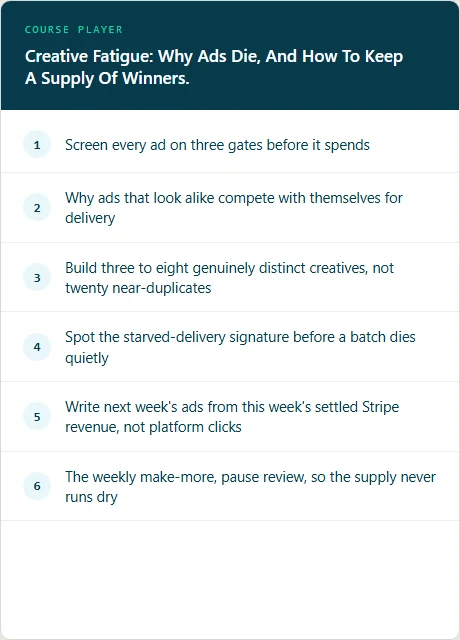
This course is one problem, six lessons, about 45 minutes: most ad review is a vibe check, so there's nothing to learn from when an ad fatigues and dies. Lessons 1 to 3 are the three-gate screen and why ads that look alike compete with themselves for delivery before they ever reach a buyer. Lessons 4 to 6 are the weekly habit: spotting starved delivery early, ranking ads on settled Stripe revenue instead of platform clicks, and writing next week's brief while this week's numbers are in front of you.
It's short because the fix is one scoring sheet and one weekly habit, not a content calendar. Six lessons is enough to run the screen and the review once, then keep running them.
The four bonuses are the real material each lesson draws on. The Book Is the Funnel, Part 4: Creative is the full part the three-gate screen and the weekly review are drawn from. TRIAD Ad Screen is the scoring sheet Lesson 1 uses. Blind Panel is the walkthrough for running the blind re-tag that produced Lesson 1's numbers. Competitor Ad Spy is the tool for checking a concept is genuinely new before you build it, the question behind Lesson 3's distinct-ads rule.
Your bonuses arrive by email within a few minutes of paying, already minted and ready to open. The course is delivered to the same email address.
Then nothing happens. There is no onboarding sequence, no upsell call, no countdown. If you want the other tools or courses, you will find them on the site. If you want us to build the rest of the sixty steps for you, the site explains how that works and what it costs, and it starts with a free teardown that might say no.
If the course does not do what this page says, reply to the receipt email and say so, any time in the first 60 days. You will get your $27 back and I will want to know what went wrong.
P.S. If you only do Lesson 1, do it. Scoring one ad on three gates before it spends changes how you look at the next twenty you were about to make.